

I-SPY 2.2 is the latest evolution in the I-SPY family of trials for early breast cancer, introducing a number of critical innovations that permit the optimization of treatment for each patient in the context of a Phase 2 signal-finding trial.
The success of the I-SPY 2 trial is not simply the result of a single innovation in trial design. It is the result of a painstaking, decade-long process of re-engineering the entire clinical trial enterprise, from protocol development through registration.

The adaptive platform approach permits parallel evaluation of multiple experimental treatments. A master protocol means treatments can come and go as they finish testing.
.svg)
Serial MRIs are used to closely monitor the impact of treatment on the tumor at multiple points before, during and after treatment. MRI non-invasively predicts whether complete response has been achieved.
.svg)
I-SPY 2.2 uses molecular 'response predictive subtypes' to characterize each participant's tumor in order to guide treatment assignments and assess subtype-specific efficacy of treatment.
.svg)
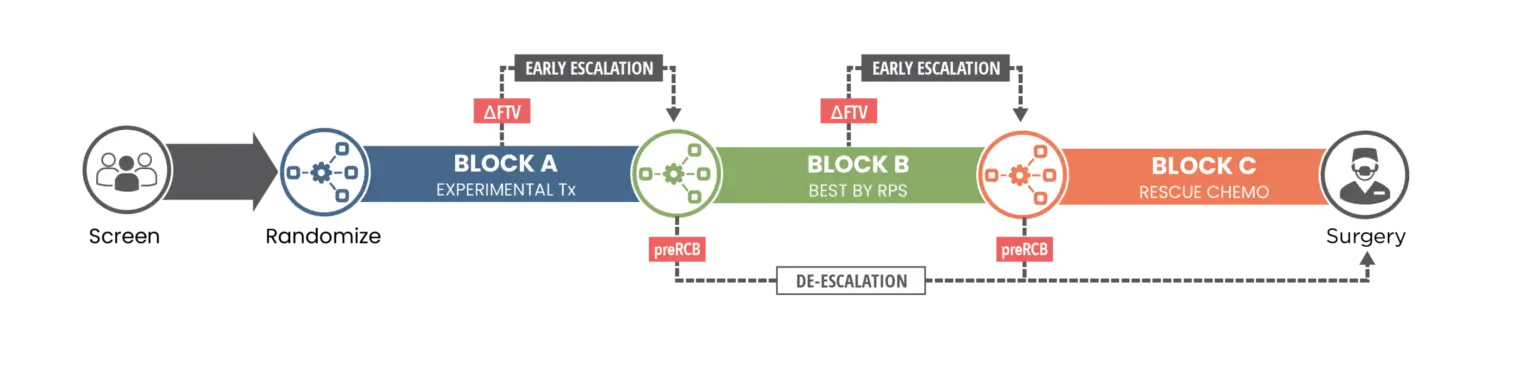
If an experimental therapy does not work, participants are switched to an established, biologically targeted therapy. Participants may receive up to 3 'blocks' of treatment in I-SPY 2.2.
.svg)
Participants get no more treatment than needed to achieve a complete response in order to limit side effects of unnecessary treatment. A key goal is to eliminate traditional chemotherapy.

In addition to assessing experimental agents, I-SPY 2.2 assesses whole treatment strategies consisting of multiple sequential treatments, more closely reflecting clinical approaches.

For over 15 years, the I-SPY breast cancer trial has consistently surpassed the general population's representation rates for Black and Hispanic patients. Additionally, the trial has made significant contributions to research on breast cancer in African American women, who are often diagnosed at a younger age and with more aggressive tumors. Recognizing that inclusive research is essential to developing effective therapies, we are committed to building programs to bring clinical trial opportunities closer to underserved communities and diverse populations.
Some breast cancers don't respond well to chemotherapy, but they may respond to hormone-based treatments. The EOP sub-study of I-SPY 2.2 tests different hormone therapy combinations before surgery in patients with HR+, HER2-negative breast cancer who are unlikely to benefit from chemo.
Patients with HR+/HER2-negative tumors and a MammaPrint Low Risk or High 1 profile are eligible for both EOP and I-SPY 2.2.
Patients with HR+/HER2-negative tumors and a MammaPrint Low Risk or High 1 profile are eligible for both EOP and I-SPY 2.2.
Patients with HR+/HER2-negative tumors and a MammaPrint Low Risk or High 1 profile are eligible for both EOP and I-SPY 2.2.
Shatsky R, Trivedi MS, Yau C, et al. Datopotamab–deruxtecan plus durvalumab in early-stage breast cancer: the sequential multiple assignment randomized I-SPY2.2 phase 2 trial. Nature Medicine. https://www.nature.com/articles/s41591-024-03267-1
Khoury K, Meisel JL, Yau C, et al. Datopotamab deruxtecan in early stage breast cancer: the I-SPY2.2 sequential multiple assignment randomized phase 2 trial. Nature Medicine.
