

Building on the success of the phase II I-SPY COVID Trial, the study infrastructure is being repurposed to rapidly screen for agents that can significantly impact Acute Respiratory Distress Syndrome (ARDS) and Acute Hypoxemic Respiratory Failure (AHRF).
In 2020, in response to the greatest public health crisis of our time, the I-SPY COVID trial launched as part of Operation Warp Speed, using its efficient platform design to rapidly evaluate multiple potential treatments to identify those with the most promise for further phase III development.
Today, the trial is expanding to identify new options for treatment of Acute Respiratory Distress Syndrome (ARDS) and Acute Hypoxemic Respiratory Failure (AHRF). ARDS alone affects approximately 190,000 Americans each year — currently, 30-50% of these patients will not recover.
A key feature of the expanded multicenter trial is to establish a precision medicine approach to ARDS and AHRF treatment, by identifying biomarkers of treatment response to provide more precise targeting of interventions.

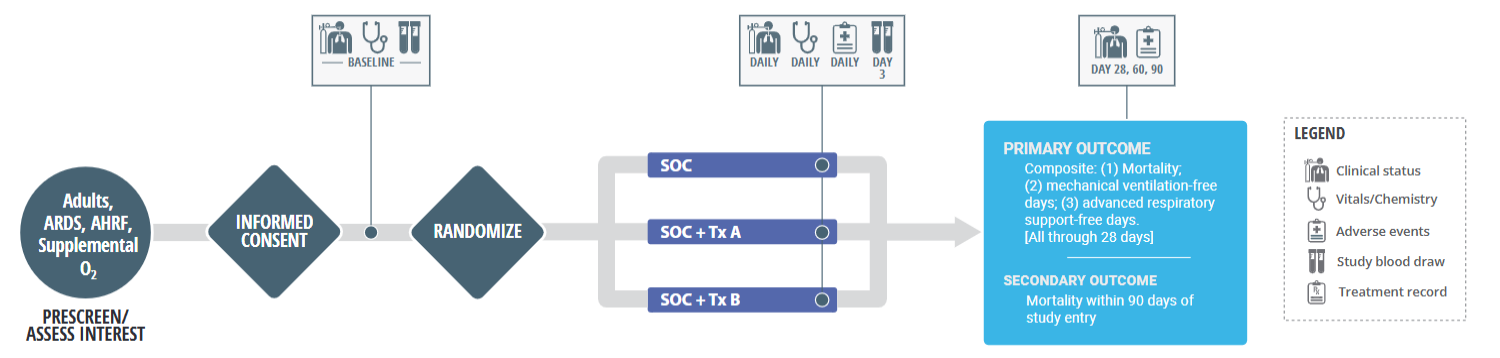
Up to six agents can be efficiently, independently evaluated in parallel. Using a master protocol means agents can enter and leave the trial with a simple amendment.

The primary endpoint is focused on mortality, ventilation and respiratory support-free days — what matters most for critically ill patients.
A wide-ranging exploratory effort accompanies the study, with a goal of identifying new biomarkers that can be used to optimize each individual's treatment.

Patients are randomized approximately equally across all arms, with up to 200 patients per agent before progression decisions are made.
All enrolled patients receive standard-of-care with or without an investigational agent.
Agents with high efficacy signals can be rapidly transitioned to study in a Phase 3 trial, shortening development time for promising treatments.
Adults with ARDS, AHRF or supplemental prescribing access interest provide informed consent and are randomized to standard-of-care or standard-of-care plus an investigational treatment. The primary outcome is a composite of 28-day mortality, mechanical ventilation-free days, and advanced respiratory support-free days at 28 days. Secondary outcomes include clinical status, study blood draws, treatment response, and mortality within 90 days of study entry.
Academic investigators interested in participating as a trial site, please get in touch to learn more about joining the I-SPY ARDS consortium.